Roasted Eggplant and Tofu Salad with Miso-Ginger-Lime Dressing
A patient once asked me whether she should stop eating tofu. She’d had breast cancer, she was five years out and doing well, and someone at her gym had told her soy was “basically estrogen.” She’d been avoiding it for two years. She missed it.
I get this question more than almost any other, and it comes with real concern, because people aren’t randomly curious; they’re afraid they’ve been poisoning themselves. So before today’s recipe, here are a few thoughts on this.
What the evidence says
Soy contains isoflavones, which are phytoestrogens that are plant compounds structurally similar enough to human estrogen to bind estrogen receptors. That is true, and it’s where the concern arises from.
Human estradiol binds both major estrogen receptor subtypes; soy isoflavones bind preferentially to ER-beta, which is distributed differently through the body and often acts in opposition to ER-alpha, the subtype most associated with breast tissue proliferation. The effect isn’t a weaker version of estrogen. In some tissues, it’s closer to the opposite.
The population data point in the same direction. Cohort studies following women after breast cancer, including large studies in both Asian and Western populations, have generally found soy food intake associated with neutral or modestly lower recurrence and mortality, not higher. Major oncology bodies now consider moderate whole-soy intake safe for survivors. Still, it is important to discuss your unique journey with your doctor.
Two honest boundaries on that. First, most of this is observational; women who eat more tofu differ from women who don’t in many ways, and cohort data can’t fully separate those. Second, whole soy foods and concentrated isoflavone supplements are different exposures, and the reassuring data is about food. Tofu, tempeh, edamame, and miso seem to be good, but high-dose extract capsules have different data and are less settled.
Miso adds fermentation, which does real work: it breaks down phytates and the oligosaccharides responsible for legume gas, and makes some minerals more available. It also adds a substantial amount of sodium. A tablespoon of miso carries roughly 600–700 mg. Important to know if you’re managing blood pressure, and it’s a caveat the fermented-foods literature tends to skip past.
What Ayurveda says
Classical texts have no entry for tofu as it didn’t travel to India in the relevant period but they have a great deal to say about legumes.
Legumes are treated as guru (heavy), cooling, drying, and astringent, which in the framework makes them vata-aggravating: gas-forming, hard on digestion, slow to move. The traditional notion is not to stop eating them but to prepare them properly, soak, cook thoroughly, and add heating, carminative spices. Ginger is a great resource for this support. This is the same logic behind every dal in the tradition.
Fermentation sits in a more complicated place. Fermented foods are considered heating and pitta-aggravating, so they’re used with more caution in summer than in winter, but they’re also recognized as more easily digested than the unfermented original.
And one clarification worth making, because the two get conflated constantly: Thai basil is not holy basil. Holy basil is tulsi, revered in Ayurveda, the plant with the adaptogen research attached to it. Thai basil is a variety of sweet basil, anise-scented, gorgeous, and culinarily a great option for this dish, but it is a different plant, and it does not carry tulsi’s claims. If a recipe tells you the Thai basil in your salad is an adaptogen, it’s wrong
Where they agree, and where they don’t
The agreement is on mechanism, and it’s genuinely impressive. Ayurveda’s insistence that legumes need help being digested tracks a real phenomenon: oligosaccharides humans can’t break down, which gut bacteria ferment. Its prescribed fixes- soaking, thorough cooking, fermentation, and ginger- are precisely the interventions that measurably reduce those compounds and improve tolerance. A tradition with no biochemistry arrived at the right protocol.
The disagreement runs in both directions, which is why I find this dish worth writing about.
Ayurveda is more cautious about soy than the evidence warrants. Framed as heavy and hard to digest, tofu is discouraged in some contemporary Ayurvedic practice, but soy is among the best-studied plant proteins; it’s complete in its amino acid profile, and the outcome data on soy foods is favorable. Heaviness is a quality judgment, not a health outcome, and I don’t think it should keep anyone off a food this useful.
The modern wellness world gets it wrong in the other direction, and worse. The soy-and-hormones fear has essentially no support in human outcome data, and it causes measurable harm — I’ve now met several women who spent years avoiding a food that the evidence suggests may have been mildly protective, on the advice of someone at a gym.
Where I’d hold the line: the sodium in miso is real, and “it’s fermented” doesn’t neutralize it. If you’re salt-sensitive, use less miso and more lime. The tradition’s enthusiasm and the modern wellness enthusiasm for fermented foods both tend to skip that part.
Now, to be clear, one hundred seventy-eight grams is about a cup and a half of fresh blueberries. Every day. For three months. That is a real commitment and considerably more than most people eat. Half a cup across four servings of this salad does not replicate a trial, and I am not going to pretend otherwise.
What it does is put August and raw blueberries in front of you as a reminder, in a form you actually want to eat, on a day you were going to eat something anyway. A single salad is not an intervention; it is one of the thirty or so different plants worth getting into a week.
So here’s what I cook
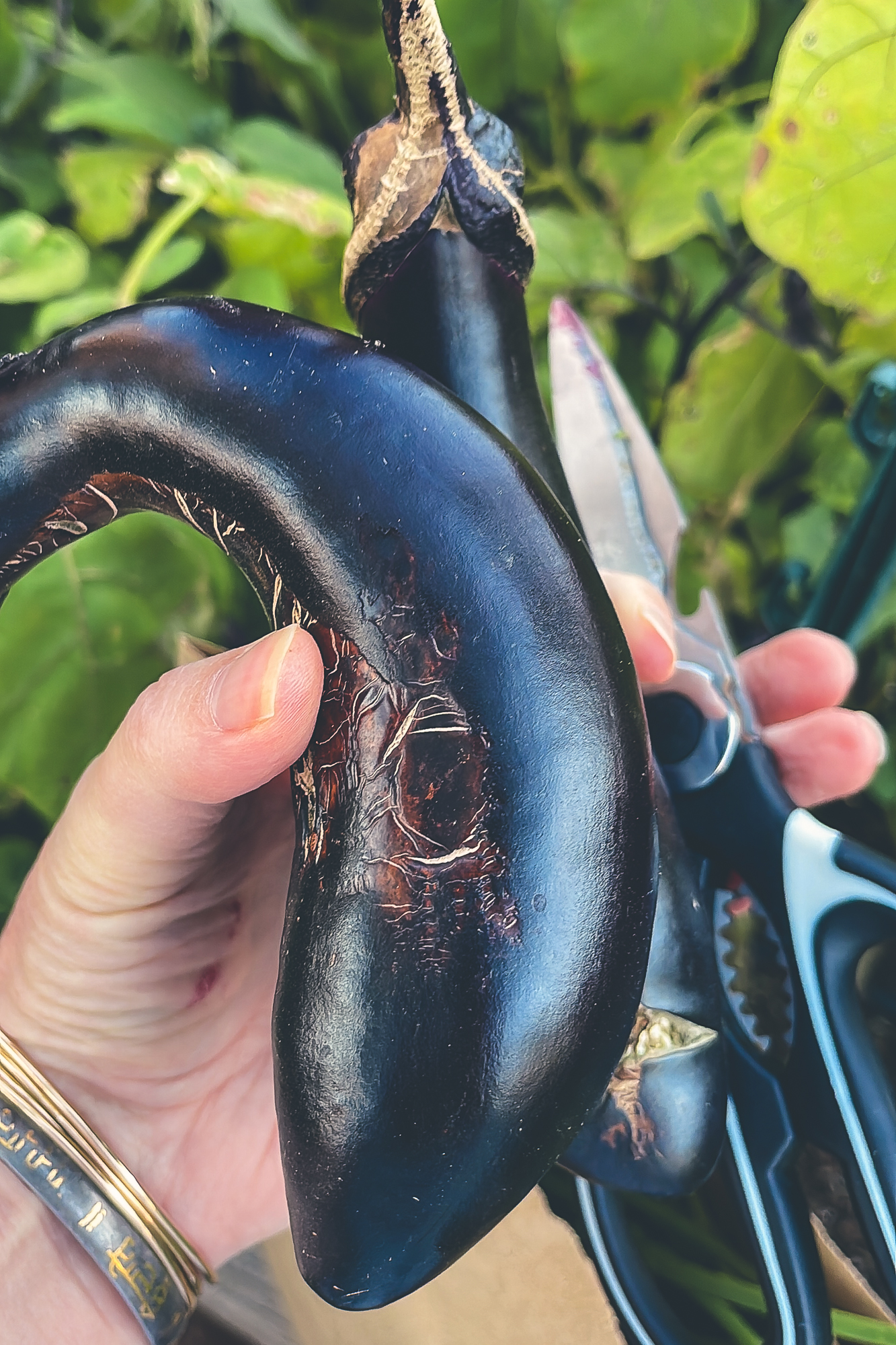
This is late-August food. The eggplant is still stacked at the market, the basil is days from bolting, and it’s still too warm to want anything heavy.
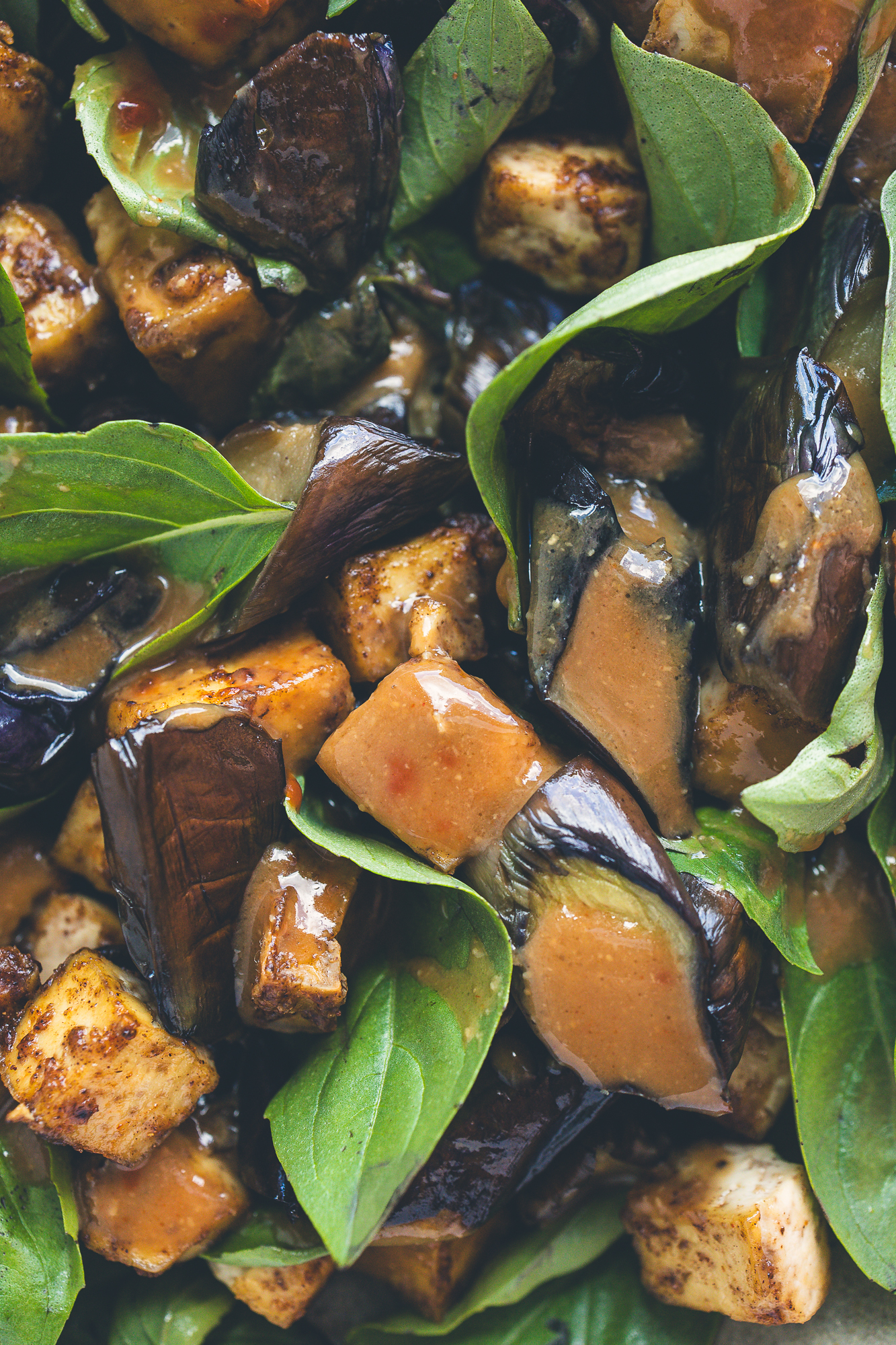
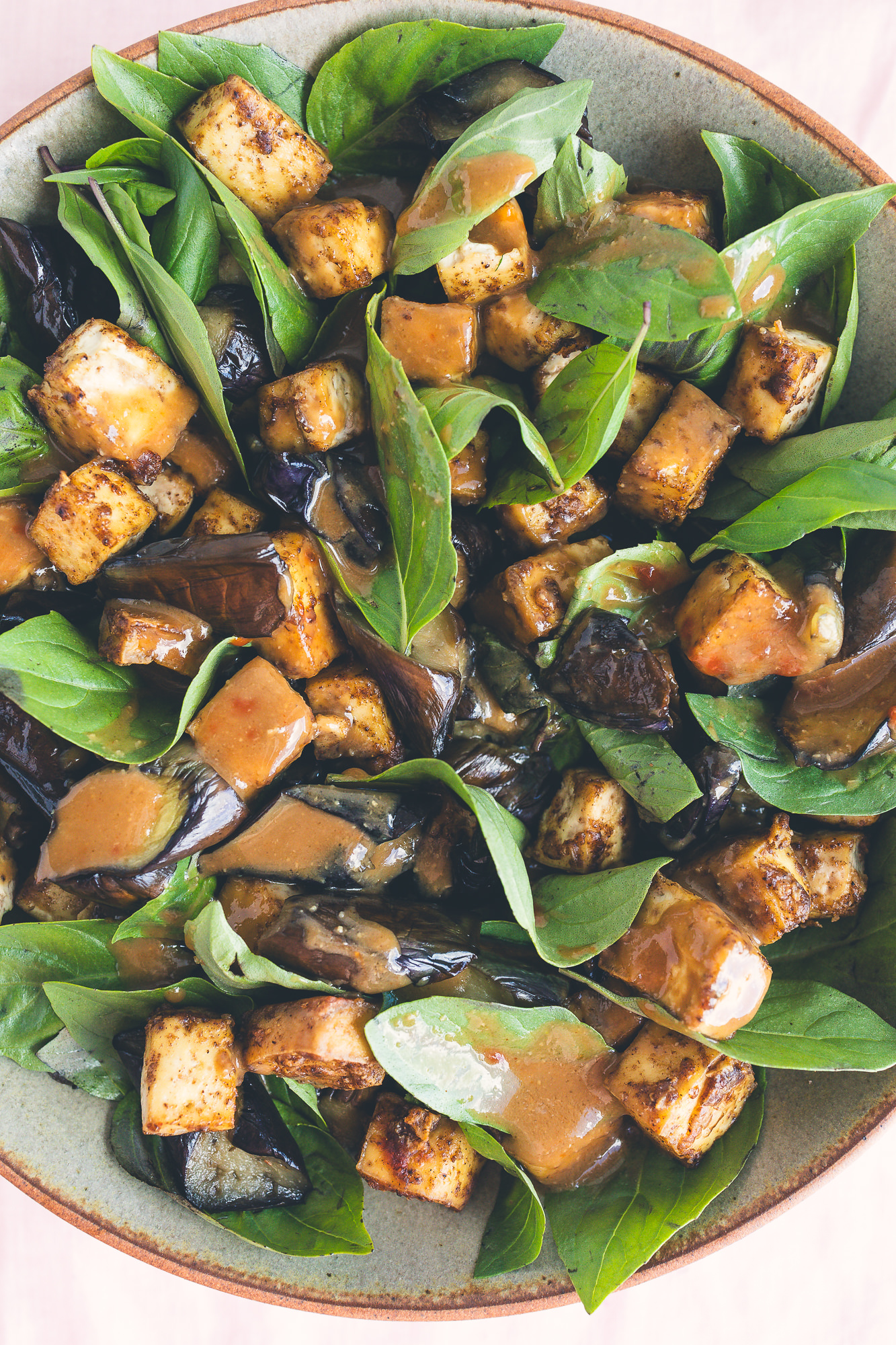
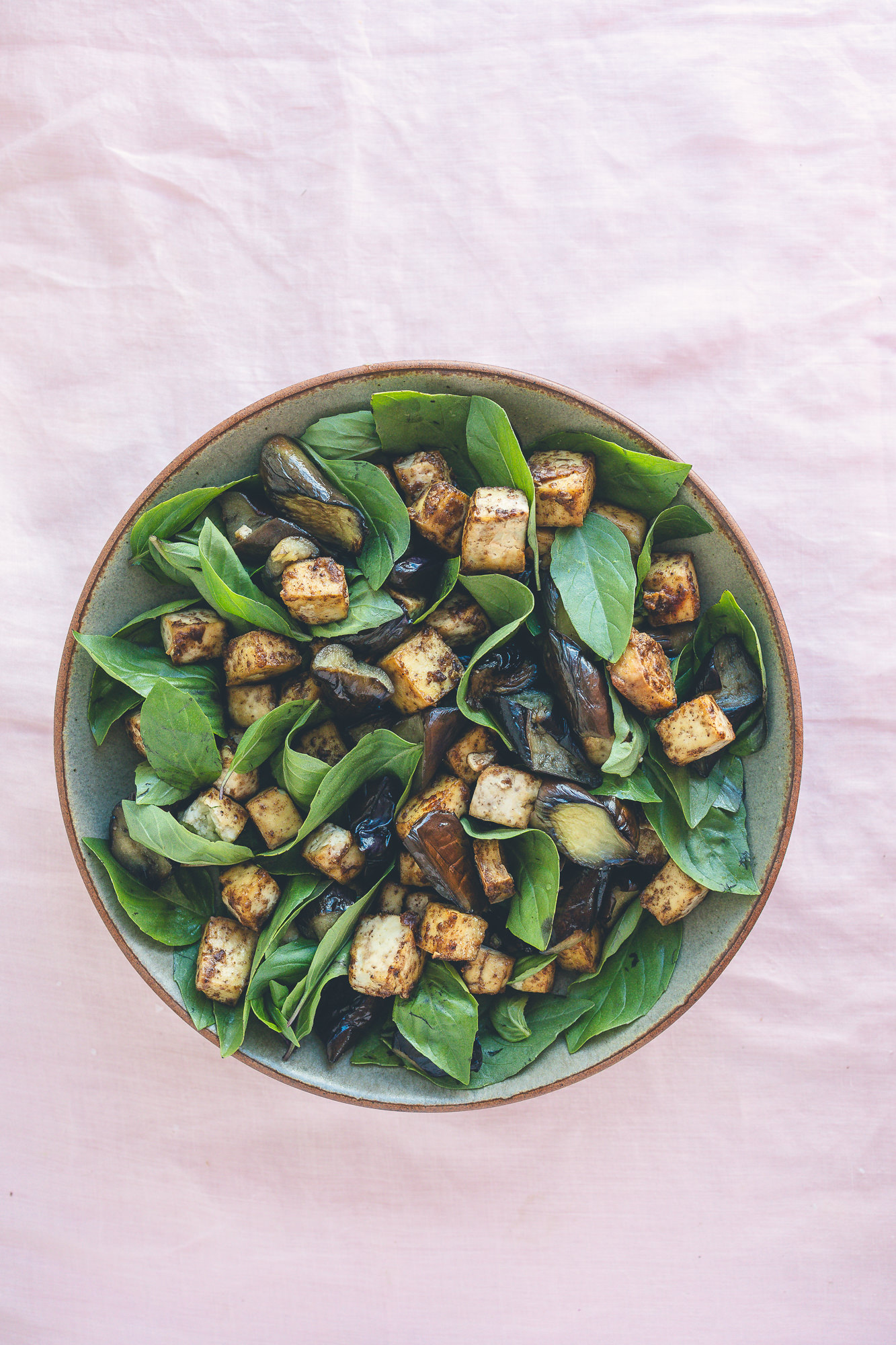
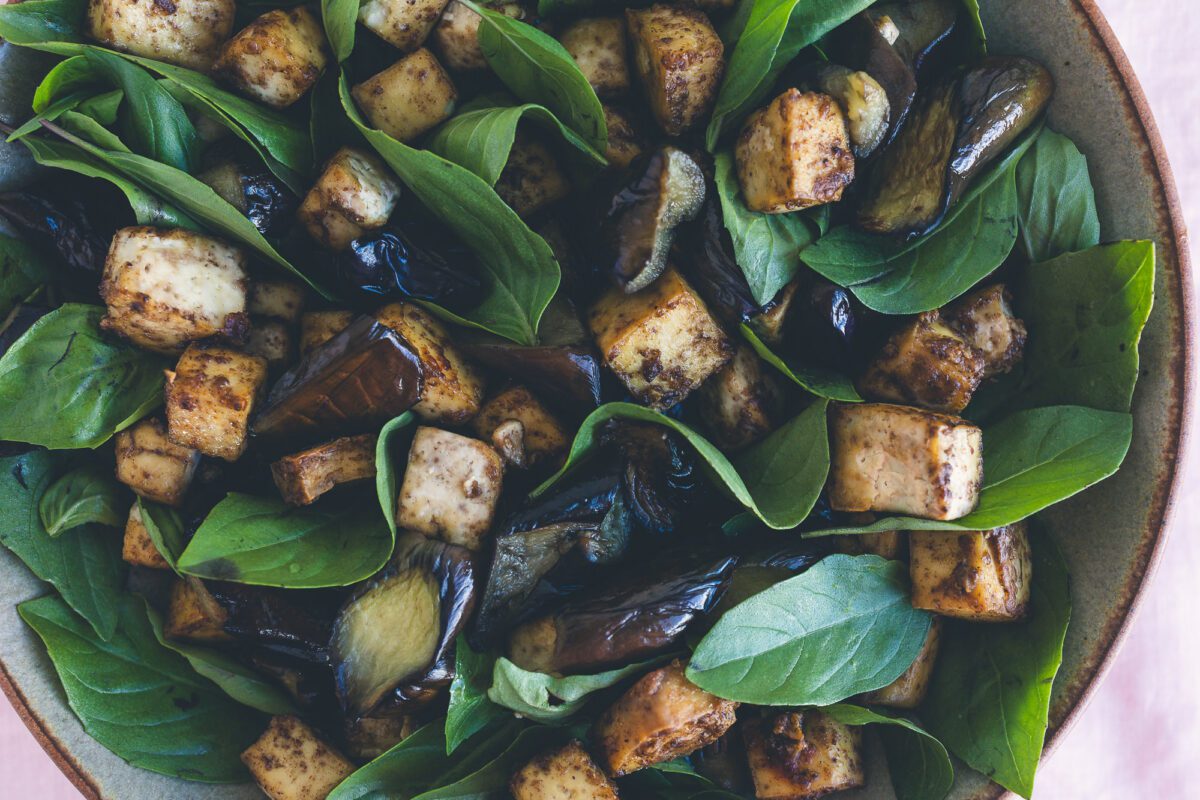
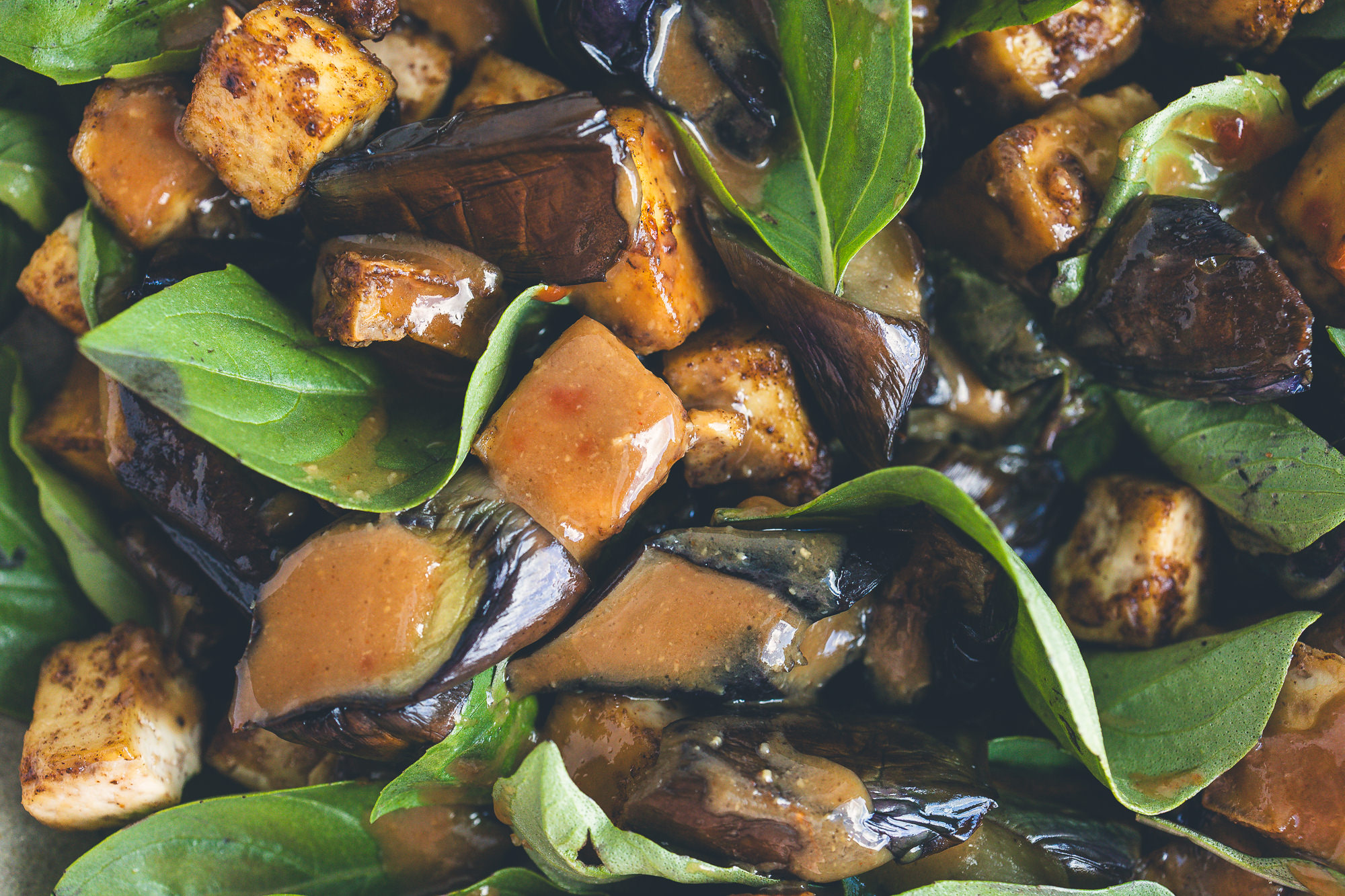
So: eggplant roasted rather than fried, tofu roasted until the edges go golden, both dressed while warm with miso, ginger, lime, and soy — and then a genuinely absurd amount of Thai basil folded in raw at the very end, so the leaves stay green and perfumed instead of collapsing into the bowl.
The construction follows the reasoning. Ginger is there because tradition says legumes need it, and because the evidence on gastric motility supports it. The dressing goes on after it comes off the heat, which keeps whatever live cultures your miso has intact. The eggplant is whole-roasted because eggplant flesh is an oil sponge and roasting collapses it first.
No garlic, which is how I cook, as it upsets my digestion. I don’t miss it here; ginger and lime carry the whole thing.
Becerra-Tomás N, Balducci K, Abar L, et al. Phytonutrients and outcomes following breast cancer: a systematic review and meta-analysis of observational studies. JNCI Cancer Spectr. 2024;8(1):pkad104. doi:10.1093/jncics/pkad104
García-Mantrana I, Monedero V, Haros M. Reduction of phytate in soy drink by fermentation with Lactobacillus casei expressing phytases from bifidobacteria. Plant Foods Hum Nutr. 2015;70(3):269-274. doi:10.1007/s11130-015-0489-2
Kucuk O. Soy foods, isoflavones, and breast cancer. Cancer. 2017;123(11):1901-1903. doi:10.1002/cncr.30614
Kuiper GG, Carlsson B, Grandien K, et al. Comparison of the ligand binding specificity and transcript tissue distribution of estrogen receptors alpha and beta. Endocrinology. 1997;138(3):863-870. doi:10.1210/en.138.3.863
Kuiper GG, Lemmen JG, Carlsson B, et al. Interaction of estrogenic chemicals and phytoestrogens with estrogen receptor beta. Endocrinology. 1998;139(10):4252-4263. doi:10.1210/en.139.10.4252
Kumari M, Kokkiligadda A, Dasriya V, Naithani H. Functional relevance and health benefits of soymilk fermented by lactic acid bacteria. J Appl Microbiol. 2022;132(1):104-119. doi:10.1111/jam.15342
Nechuta SJ, Caan BJ, Chen WY, et al. Soy food intake after diagnosis of breast cancer and survival: an in-depth analysis of combined evidence from cohort studies of US and Chinese women. Am J Clin Nutr. 2012;96(1):123-132. doi:10.3945/ajcn.112.035972
Paruthiyil S, Parmar H, Kerekatte V, Cunha GR, Firestone GL, Leitman DC. Estrogen receptor beta inhibits human breast cancer cell proliferation and tumor formation by causing a G2 cell cycle arrest. Cancer Res. 2004;64(1):423-428.
Rock CL, Thomson CA, Sullivan KR, et al. American Cancer Society nutrition and physical activity guideline for cancer survivors. CA Cancer J Clin. 2022;72(3):230-262. doi:10.3322/caac.21719
Viscardi G, Back S, Ahmed A, et al. Effect of soy isoflavones on measures of estrogenicity: a systematic review and meta-analysis of randomized controlled trials. Adv Nutr. 2025;16(1):100327. doi:10.1016/j.advnut.2024.100327
Roasted Eggplant and Tofu Salad with Miso-Ginger-Lime Dressing is a wonderful dish that can be served warm or cool depending on your preferences.
Ingredients
UnitsScale
For the salad
1lbeggplant (2 Japanese, or 1 medium globe), cut into 1-inch pieces
14ozextra-firm tofu, cut into 3/4-inch cubes
1 tbsp neutral oil, divided
1 tbsp soy sauce or tamari
1 tsp cornstarch (enough to lightly coat)
2 packed cups Thai basil leaves, left whole
Toasted sesame seeds, to finish
1 tsp Chinese 5 Spice optional
For the miso-ginger-lime dressing
2 tbsp white or yellow miso
1 tbsp fresh ginger, finely grated ( i prefer more ginger taste, could do less)
2 tbsp lime juice (about 1 lime)
1 tbsp neutral oil
2–3 tbsp water, to loosen
Sliced red chili, optional, or Gochujang fermented sauce
Make it yours
Roasted eggplant and tofu keep four days refrigerated, but the basil doesn’t, so dress and fold in fresh leaves each time you eat it rather than storing the finished salad. Roast a double batch of both components on a Sunday and this becomes a five-minute weeknight dinner.
Oil-free: skip the oil entirely, roast both on parchment, and add a tablespoon of water to the dressing in place of the sesame oil. You lose some crispness on the tofu and some aroma in the dressing; it still works.
Thai basil is genuinely hard to substitute — the anise note is the point. Italian basil plus a pinch of crushed fennel seed gets you closest. Mint is a different but good dish.
To make it a fuller meal: add edamame, roasted sweet potato, or a soft-boiled egg if you eat them. Over cold soba noodles, it feeds six.
Who this isn’t for
If you’re managing hypertension or on a sodium-restricted diet, halve the miso and soy sauce and lean on lime and ginger as the dressing carries fine. Soy allergy is a true allergy and this dish isn’t adaptable around it. And if you’re on levothyroxine, soy can interfere with absorption; the standard advice is separating soy foods from the dose by a few hours, which is worth confirming with your prescriber rather than with me.
Questions I get
Is tofu bad for you if you’ve had breast cancer? Current evidence says no — cohort studies of breast cancer survivors have generally found whole soy food intake associated with neutral or slightly lower recurrence and mortality, and major oncology guidance considers moderate intake safe. The caution that remains is around concentrated isoflavone supplements, which are a different exposure than food. Bring it up to your oncologist to explore your unique needs.
Does soy raise estrogen levels in the body? Soy isoflavones bind estrogen receptors, but preferentially to ER-beta rather than the ER-alpha subtype most associated with breast tissue proliferation so the effect is not equivalent to raising estradiol. Human trials of soy food intake have not shown clinically meaningful hormonal disruption in either women or men.
How do you get tofu crispy without deep frying? Press it, coat it with soy sauce, then cornstarch, then oil in that order, and roast at 375°F on parchment without crowding the pan. The cornstarch gelatinizes and dries into a thin shell.
Does heating miso kill the probiotics? Yes, sustained heat inactivates the live cultures, which is why traditional miso soup is finished off after the boil. In this recipe the dressing is not cooked, so if you’re using unpasteurized miso the cultures survive. Most supermarket miso is pasteurized already, in which case the question is moot and you’re eating it for flavor and the products of fermentation, which is a perfectly good reason.
What can I use instead of Thai basil? Italian basil with a pinch of crushed fennel seed comes closest to the anise character. Mint makes a different but genuinely good version. Cilantro works if you like it. Thai basil is not the same plant as holy basil (tulsi), so don’t substitute tulsi expecting the same flavor.
Can I make this ahead? Roast the eggplant and tofu and mix the dressing up to four days ahead and refrigerate separately. Combine and add fresh basil at the moment you eat, assembled and stored, the leaves blacken within hours.
Is miso too salty to eat regularly? A tablespoon carries roughly 600–700 mg of sodium, so it’s a meaningful contributor if you’re watching intake. For most people in the context of an otherwise low-processed diet it’s fine; if you’re managing blood pressure, use half and add more lime.
Learning about Plant-Based Eating
Having the right resources to learn about plant-based vegan principles is important for everyone.
These books are among my tried-and-true favorites, ones I have repeatedly referred to over the years. Let me know if you pick any of them up and what you learn.
Join me in the community!
Looking to make a positive change in your life and community clinically? Dr. SiriChand is a board-certified physician in Internal Medicine, Integrative Medicine, Lifestyle Medicine, and Hospice/Palliative Medicine. She has dedicated her career to promoting long-term vitality through the choices we make every day and is an expert in Ayurveda and plant-based nutrition.
She works with physicians to explore how to create time for self-care and how to learn to innovate in their integrative medicine careers. Take the first step toward an aligned, happier future by learning more about the community we are creating today.
Let’s create a better world for female physicians through intentional, mindful living.
If you make this, tag me on social media at @doctorsirichand. I would love to see your variations and flavor options.
Save this Recipe for later to your favorite place. I prefer using Pinterest, but you can also clip it elsewhere.
Dr. Siri Chand
SHARE
May your life be nourished and vital!
*Please note as an affiliate, I earn from qualifying purchases which means I will receive a small fee if you purchase them. I have only included things I truly use. This post is for educational and informational purposes only and solely as a self-help tool for your own use. I am not providing medical, psychological, or nutrition therapy advice. You should not use this information to diagnose or treat any health problems or illnesses without consulting your own medical practitioner. Always seek the advice of your own medical practitioner and/or mental health provider about your specific health situation. For my full Disclaimer, please go here.






















Be the first to comment